
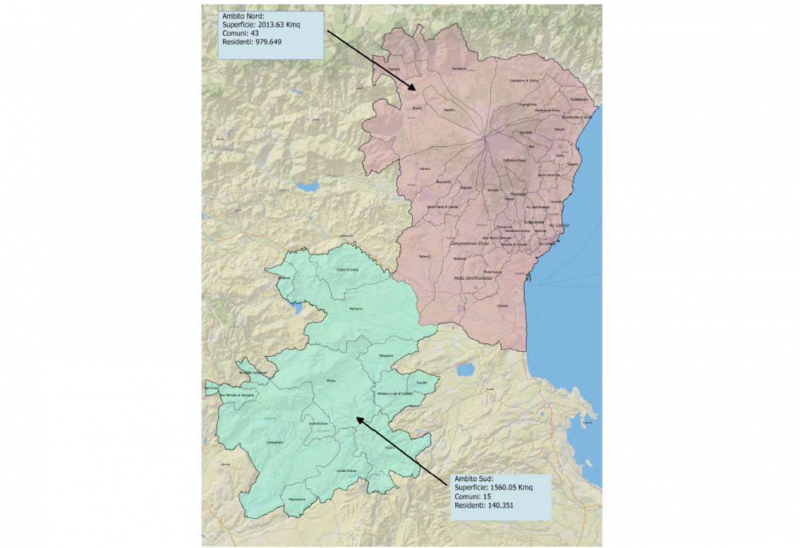

Catania is not a water-scarce region. The entire province relies on one of Sicily’s most significant groundwater reserves: the Eastern Etna aquifer. The 2019 area plan is characterized by a certain vagueness regarding the definition of water losses. “At the provincial level, the average distribution loss, calculated based on data as the ratio of the difference between the volume fed into the network and the volume billed to the billed volume itself, stands at around 51%,” the report states. Notably, losses are reported by utility operator rather than by municipality, revealing extreme disparities: for instance, the Acoset Spa waterworks, serving 21 municipalities in the foothills, reports a 72% loss rate, whereas the “Pavone” system, covering the area between Giarre and Zafferana, reports losses just above 5%. According to Istat, the loss rate in the provincial capital is approximately 40.4%.
A distinctive feature of the Catania water system is that, unlike almost the rest of the island, there is an abundance of water, exceeding actual needs. “Theoretically, water resources exceed demand by about 50%. Nevertheless, service disruptions occur due to failures in pumping stations, burst pipes, and, more generally, losses during transmission and distribution,” the report explains. Furthermore, there is a marked disparity in resource availability between the water-rich Etna foothills and metropolitan area, and the Calatino district, where water is scarce.
This is because the Catania area is served by a network of 6,287 kilometers of pipelines: a vast, multi-layered system that has evolved since the 1960s. In many instances, the pipes are made of materials now considered obsolete and were installed within an urban landscape vastly different from today’s. “Some sections are made of materials that, while deemed suitable at the time of installation, are now considered potentially hazardous to health (such as asbestos-cement) or unfit for use (such as galvanized sheet metal),” the document explains.
Indeed, it is no coincidence that technical documents classify several sections as being in a “sufficient” or “poor” state of repair. For example, 4.1% of the total pipeline network was built before 1950, as were 9.2% of the storage tanks and 11.7% of the distribution networks. From an organizational standpoint, the abundance of water resources in the aquifers around Mount Etna has led to a proliferation of water supply and distribution entities.
Find out about the situation in other Sicilian provinces here.