
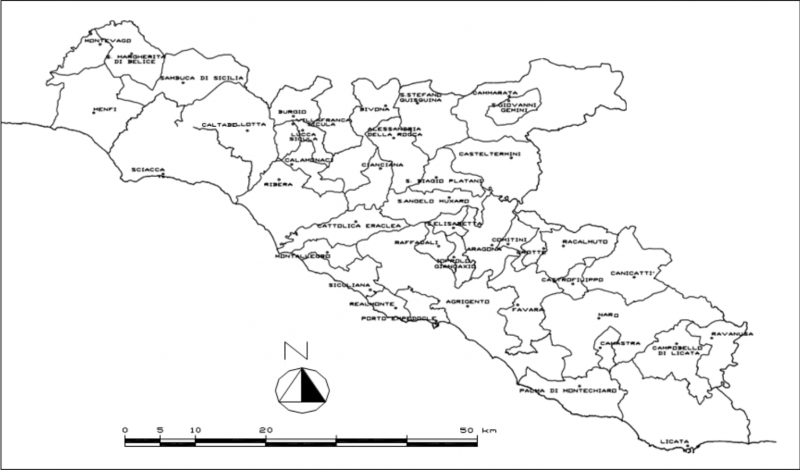

The province historically most affected by water scarcity is Agrigento, which faces two critical issues: a lack of self-sufficiency regarding water supply and a rate of water loss that, at the provincial level, well exceeds 50%, reaching a critical 68.8% in the area managed by the Single Operator. In technical terms, more than two-thirds of the water fed into the system is lost before it can be metered, a figure reflecting both physical losses (pipe bursts) and apparent losses. The 2020 Area Plan which updated an earlier 2002 assessment by Sogesid, showed that the main operator (ATI AG9) handled an annual volume of 44.93 million cubic meters of water fed into the system. Of this volume, the amount actually billed to end-users was only 13.98 million cubic meters.
Furthermore, Agrigento has historically struggled to source this water: according to the baseline infrastructure assessment (conducted by Sogesid), local production within the area (sourced from 387 wells, 89 springs, and 3 intakes) yields approximately 29.00 million cubic meters per year. To meet total demand, the ATI is required to purchase an additional 17.03 million cubic meters per year, roughly 38% of the total input, from the supra-area operator (Siciliacque S.p.A.). The slight discrepancy between the total potential resource (approximately 46.03 million cubic meters) and the actual volume fed into the system (44.93 million) is attributable to losses occurring along the major transmission mains.
The system is supplied by the following main networks: the Voltano, Fanaco, and Tre Sorgenti aqueducts, and the Gela-Arancio system. This setup highlights an economic and structural paradox: the province purchases external water supplies to offset local shortages, only to lose two-thirds of that water due to dilapidated infrastructure. Indeed, 30.4% of the networks were built before 1990, and while there is no available data on the age of approximately 36% of the infrastructure, various press reports mention extensive sections dating back to the 1950s and 1960s. Regarding operational performance, 28.4% of the networks are rated as having insufficient, mediocre, very poor, or low functionality. No performance assessment is recorded for 29% of the networks. The use of obsolete materials and the lack of cathodic protection make the networks prone to frequent ruptures, exacerbated by the mechanical stress of “water hammer” effects caused by constant supply-rotation maneuvers: rotations that, in many municipalities, occur every four or five days.
Find out about the situation in other Sicilian provinces here.