


Sicily’s system of artificial reservoirs was developed primarily after the Second World War to address one of the main challenges posed by the Mediterranean climate: the marked time lag between the availability of water resources, concentrated in the autumn and winter months, and agricultural and domestic demand, which reaches its peak in spring and summer. This need was further intensified by the characteristics of the island’s hydrographic network, which consists mainly of short, torrential watercourses that are poorly suited to large-scale direct abstraction. In this context, the construction of retention dams represented the most effective solution for storing water during rainy periods and making it available during the dry season.
The Regional Plan to Combat Drought, drawn up by the Basin Authority of the Sicilian Hydrographic District and approved by Presidential Decree No. 7 of 2020, and, more recently, the Draft Report on the Management of the State of Emergency in Relation to the Severe Water Deficit and the Critical Condition of Infrastructure in the Territory of the Sicilian Region, approved by the Audit Section of the Italian Court of Auditors for the Sicilian Region through Resolution No. 213/2025/GEST of 7 August 2025, provide a snapshot of the current condition of Sicily’s reservoirs.
Of the 45 retention dams shown above (see Figure 1), only 19 are operating normally, meaning that they are authorised to store water up to the maximum design level; 9 have undergone final testing but are subject to storage restrictions imposed by the supervising Ministry because of shortcomings in extraordinary maintenance; 11 are in the experimental impoundment phase, which is preparatory to final testing; 4 dams are out of service—Cuba, Pasquasia, Comunelli and Gibbesi—and 2 are still under construction—Pietrarossa and Cannamasca.
In addition to the 45 dams listed above, the following major unfinished dams should also be mentioned for the sake of completeness:
- The Blufi dam, on the stream of the same name, within the municipality of Blufi, in the province of Palermo, intended for drinking-water supply. The concession was requested by the Sicilian Aqueduct Authority, which was subsequently abolished. Responsibility for the project currently lies with the Regional Department of Water and Waste of the Sicilian Regional Government.
- The Laura dam, on the Mendola stream, within the municipality of Campobello di Licata, in the province of Agrigento, intended for irrigation. The concession was requested by the Lower Salso Land Reclamation Consortium, which was subsequently abolished.
- The Piano del Campo dam, within the municipality of Corleone, in the province of Palermo, on the right-hand branch of the Belice River, intended for irrigation. The concession was requested by the Upper and Middle Belice Land Reclamation Consortium, which was subsequently abolished.
The restrictions on reservoir storage, however, have widely differing causes. In some cases, they are due to the deterioration of bottom or surface outlet structures; in others, to the failure to complete the inspections and seismic upgrades required under regulations introduced in 2014. There are also heavily silted reservoirs in which sediment accumulation has significantly reduced usable capacity, as well as cases in which design-related problems dating back to the original construction remain unresolved, as with the Disueri and Trinità dams. These situations are compounded by projects that were never completed, foremost among them the Blufi dam, which is regarded as one of the infrastructure projects with the greatest potential to strengthen Sicily’s water-storage capacity.
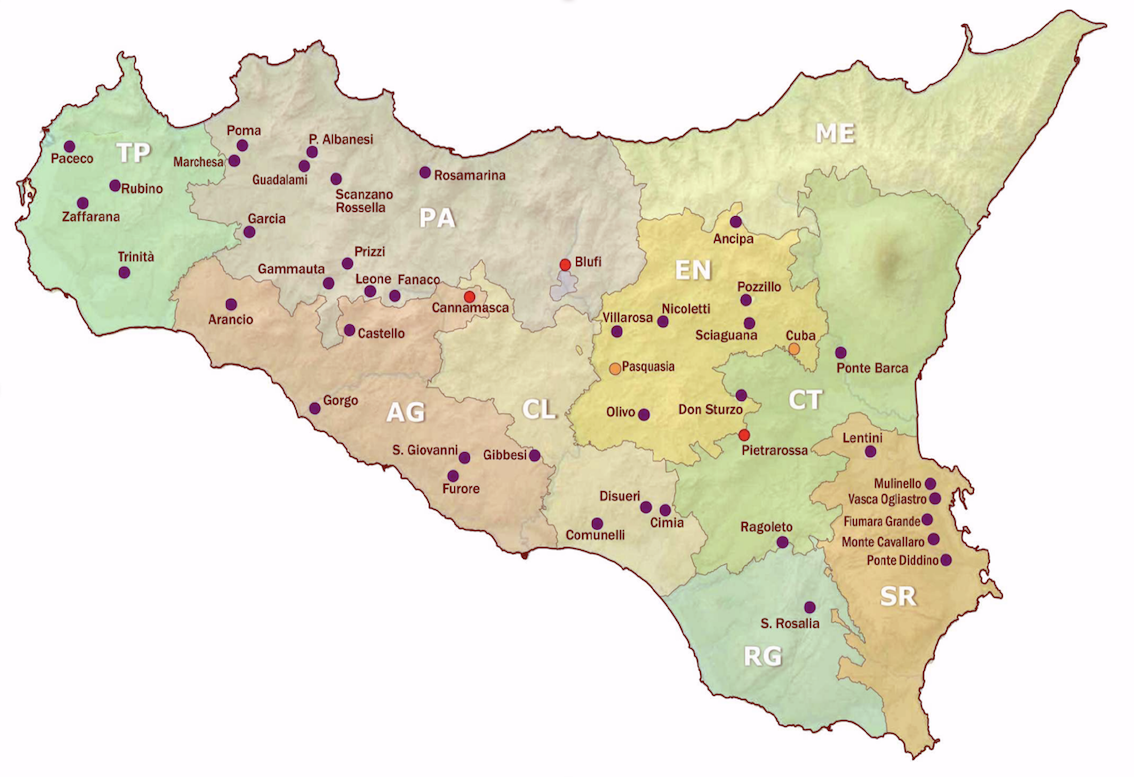
Figure 1. Location of the retention dams: dams in operation are shown in blue, dams under construction in red, and dams out of service in yellow (excerpt from the 2020 Regional Plan to Combat Drought).
The distribution of reservoirs is not uniform across the region. The province of Messina, for example, is almost entirely devoid of large dams, with the exception of the portion of the Ancipa reservoir that falls within the province, due to the geological and morphological characteristics of the area. The drainage basins on both the Tyrrhenian and Ionian sides are very short and characterised by steep gradients, while the high level of urbanisation in the few available flat areas makes the construction of new reservoirs even more difficult.
Only 19 of Sicily’s 45 reservoirs are currently authorised to store water up to the maximum design level. These include strategic infrastructure such as Ancipa, Fanaco and Santa Rosalia, while other reservoirs are subject to relatively limited restrictions, including Piana degli Albanesi and Castello. Alongside these cases, however, there are numerous basins subject to very significant limitations, which substantially reduce the overall storage capacity. As a result, against a design volume of more than 1.097 billion cubic metres, the volume actually authorised amounts to approximately 724.7 million cubic metres. From this quantity, the Regional Plan to Combat Drought deducts approximately 100 million cubic metres of sediment accumulated in the reservoirs, estimated at around 10% of total capacity, thereby identifying an immediately recoverable volume of 300 million cubic metres. The report by the National Steering Committee, established under Decree-Law No. 39 of 14 April 2023, known as the “Drought Decree”, and obtained by the Court of Auditors during the investigation leading to Resolution No. 213/2025, subsequently updated the estimate of recoverable volume to 372.78 million cubic metres (approximately 34% of the design volume). Recovering this capacity would require an estimated investment of around €510 million.
An emblematic example is the Pozzillo reservoir in the province of Enna. It has a design volume of 150.5 million cubic metres, but only 60 million cubic metres are authorised for use. The same facility also has a bottom outlet obstructed by sediment and an estimated 30 million cubic metres of siltation.
The problems affecting reservoirs are compounded by equally serious issues involving water conveyance and distribution networks. The pipelines carrying water from reservoirs to drinking-water and irrigation systems are often obsolete and prone to frequent failures, causing substantial losses before the resource even reaches end users. Reducing leakage is therefore at least as strategically important as restoring reservoir capacity, since a considerable share of the available water is lost during transmission.
These problems are also unevenly distributed across the region. Water availability varies considerably between different parts of Sicily depending on rainfall, reservoir storage capacity and the availability of groundwater resources. In some cases, transferring water between drainage basins can mitigate local shortages, but such operations are costly and constrained by the capacity of existing infrastructure.
Restoring the full functionality of the reservoirs is undoubtedly one of the priority measures, but it would not be sufficient on its own to resolve the problem of water scarcity. Extreme events such as the 2024 drought have shown that even where infrastructure is fully operational, a rainfall deficit may far exceed the available storage capacity. The case of the Ancipa reservoir is particularly significant: despite being free from operational restrictions, it was close to overflowing in June 2023 and had become almost completely empty by September 2024. Water availability therefore depends not only on reservoirs, but also on climatic trends, the distribution of rainfall, the availability of groundwater resources and the efficiency of the entire distribution system.
Numerous attempts have been made to call for public intervention to improve the efficiency of the system. By way of example, General Roberto Jucci, Extraordinary Commissioner for the water emergency between 2000 and 2001, stressed in one of his reports the need to complete the Blufi, Pietrarossa and Gibbesi dams, repair the main water conveyance pipelines and provide every municipality with an updated map of its water network. No operational trace of that report or its recommendations, however, appears to have survived.
More recently, the Regional Plan to Combat Drought identified, for dam-related measures alone, a financial commitment of approximately €210 million covering 29 structures, through various funding instruments: the 2014–2020 FSC Infrastructure Operational Plan, the Sicily ERDF Operational Programme, the Pact for the South and the National Water Sector Investment Plan. These resources were supplemented by estimated funding for the consortium-based irrigation sector (amounting to approximately €380 million) and for drinking-water networks, amounting to approximately €500 million. The total funding requirement for dredging the main reservoirs was estimated at €800 million.
More specifically, the Plan outlined a strategy structured across three time horizons. In the short term: complete final testing procedures and remove reservoir storage restrictions; build compensation tanks downstream of the Poma and Rosamarina reservoirs; begin using dead-storage volumes; maintain diversion weirs; and approve reservoir management plans. In the medium term: complete the works already under way on the dams; improve on-farm irrigation systems; restore the efficiency of consortium-managed networks; begin constructing small hillside reservoirs; and carry out works on drinking-water networks. In the long term: complete the dams still under construction—Pietrarossa, Blufi and Cannamasca; carry out dredging works; interconnect water-supply systems; and test the reuse of treated wastewater. Work on the Pietrarossa dam, one of the long-term projects, finally began in September 2023 with funding from the National Recovery and Resilience Plan. For the Blufi dam, only the final design phase has been funded, at a cost of approximately €4.8 million, and actual construction work has yet to begin. The Cannamasca dam remains at a standstill.
Although programmes and, overall, financial resources are therefore not lacking, the problem identified by the Court of Auditors is the inability, due to incomplete or poorly accessible documentation, to determine precisely how much funding has actually been spent, on the basis of which project plans and with what results. Another obstacle to improving the efficiency of the water-supply system is a fragmented governance structure organised across several administrative levels. The Basin Authority of the Sicilian Hydrographic District is responsible for planning and regulating the use of water reserves, while the operational management of reservoirs is entrusted to a number of different bodies. Following the declaration of the state of emergency, a Regional Steering Committee was also established, coordinated by the Civil Protection Department, with responsibility for planning and implementing emergency measures.
The reservoirs are currently managed by six different types of managing body. The Regional Administration, through the Regional Department of Water and Waste, manages 26 reservoirs; 3 reservoirs are managed by Land Reclamation Consortia; 2 are managed by Siciliacque S.p.A. for drinking-water purposes; 8 are managed by ENEL S.p.A., mainly for hydroelectric uses; 3 are managed by Priolo Servizi, primarily for industrial purposes; 1 reservoir is managed by Bioraffineria di Gela; 1 is managed by the Termini e Foderà agricultural company, namely the Marchesa reservoir; and 1 reservoir, Cuba, which is out of service, currently has no managing body.
This fragmentation is compounded by the equally critical fragmentation of the Integrated Water Service, which has so far been organised into nine Optimal Territorial Areas corresponding to provincial boundaries rather than drainage basins, as required by legislation and as is the case in most Italian regions. The result is that each drainage basin is managed by several different bodies, with little or no coordination.
To move beyond this fragmented model and manage the regional water service uniformly throughout Sicily, a government-sponsored bill has recently been drafted. Its most significant innovation is the transition from the current nine territorial areas, corresponding to the island’s former provinces, to a single Optimal Territorial Area. The hope is that this proposal will lead to genuine structural change, an essential prerequisite for integrated investment planning, uniform tariff-setting and more effective protection of water resources for the benefit of all Sicilian citizens.
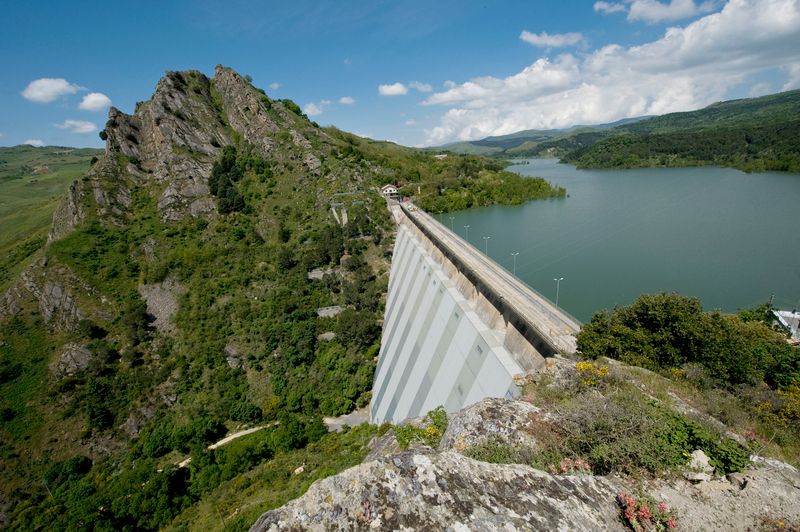
Cover photo: Dam on Lake Ancipa. Photograph by Renato Franceschin – https://www.flickr.com/photos/enelsharing/16750196520