
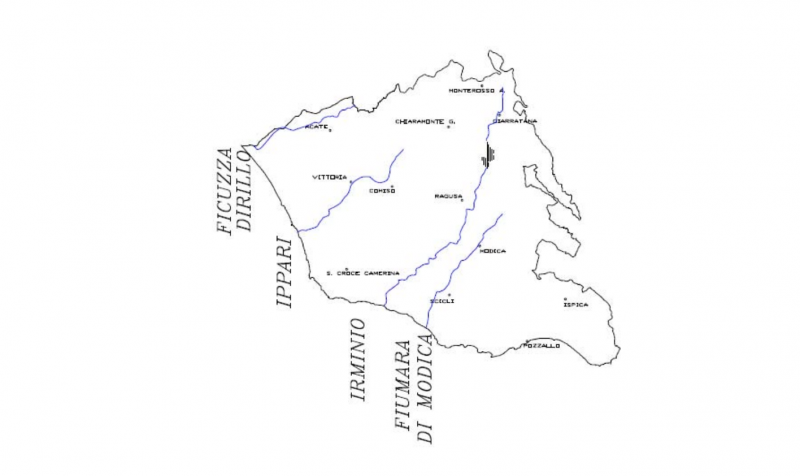


The Ragusa area plan also dates back to 2002, although the data were updated in 2008, revealing two different leakage figures: 49% loss relative to billed volume and 34% relative to supplied volume. These figures highlight a province operating at two speeds: average losses based on supplied volume, calculated against the volume fed into the network, stand at approximately 34%, whereas losses based on billed volume show a higher figure of 49%. The figures vary significantly from one area to another. Some municipalities, such as Acate, report zero losses, contrasting with the provincial capital, which loses 51% of its supplied volume (and records a 65% loss in billed volume). There is also the paradoxical case of Santa Croce Camarina, which loses not a single drop of supplied volume yet fails to bill for 71% of the water it supplies. Losses in the transmission network are also extremely low, recorded at 2%. In contrast, the provincial capital reports losses in the order of 46.5%, according to 2022 ISTAT data.
The operational status of the nine wells, with the exception of four showing only mediocre functionality, is described in the plan as “more than satisfactory to date”; similarly, the 32 springs (excluding two inactive ones) show a functionality level that is “at least sufficient.” The assessment is also broadly positive for approximately 84% of the transmission mains, considered to have at least sufficient functionality, and for 91% of the municipal storage tanks; according to the plan, the latter show at least “sufficient” functionality, with 34% demonstrating a “good/excellent” level.
Regarding the functionality of the 68 monitored networks, in many instances, the technicians responsible for the service did not provide a qualitative assessment. Regarding the year of construction, 13 of the networks were built before 1950 and 36 between 1950 and 1990, while the remaining 18 distribution networks were completed after 1990.
Find out about the situation in the other Sicilian provinces here.