
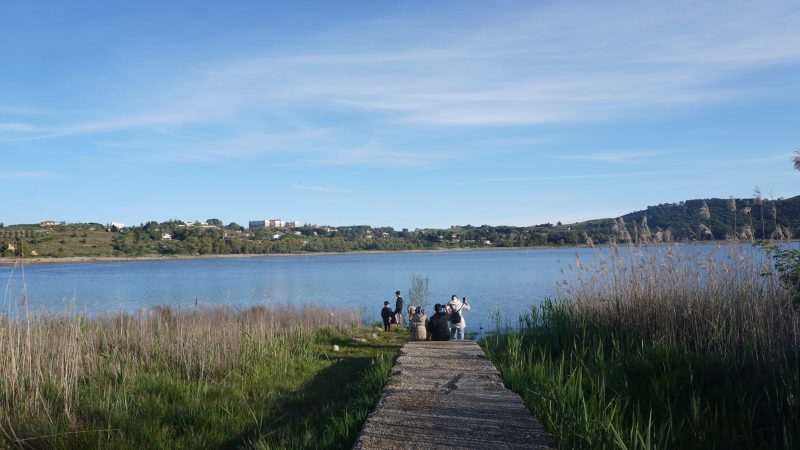

To reach Lake Pergusa from the centre of Enna, passengers must board enormous red buses bearing the SAIS logo. In the absence of a public urban transport company, the historic private Sicilian operator is responsible for moving approximately 27,000 residents every day across Enna’s winding municipal territory. Dressed in jackets and ties, the drivers travel through a landscape of descents and climbs reaching elevations of up to 900 metres above sea level, making Enna the highest provincial capital in Italy. The city is divided into three distinct urban sections: at the top, the historic centre, perched on the Erei Mountains and overlooking the Dittaino Valley, retains the typical layout of Sicily’s inland towns; further down, the area associated with Kore University has developed over the past few decades, a private university founded in 2005 that now attracts thousands of students from across Italy. Then, heading south along the road to Piazza Armerina, the built-up area gradually thins out, the hills open up, the landscape descends and, after a few kilometres, the basin of Lake Pergusa emerges almost like an appendage, giving its name to the surrounding village.
 “Pergusa is a natural thermometer of climate change,” says Giuseppe Maria Amato, an anthropogeographer, environmental consultant and scientific coordinator of the Rocca di Cerere UNESCO Global Geopark. According to UNESCO, a geopark is “a single, unified geographical area where sites and landscapes of international geological significance are managed through an integrated approach combining protection, education and sustainable development”. There are more than two hundred geoparks worldwide, distributed across dozens of countries. “The history of this place is extremely ancient. Ovid, Cicero and Livy all wrote about it: it was the locus amoenus par excellence,” he explains, “an area where nature, water and myth are intertwined.” Pergusa was a landmark of the classical world, a fertile place rich in vegetation and water. According to mythological tradition, this was the setting for the abduction of Persephone: the daughter of Demeter, goddess of fertility, was kidnapped by Hades while gathering flowers along the shores of the lake and dragged down into the Underworld. The cycle of the seasons is said to originate from her mother’s grief: spring and summer coincide with Persephone’s return to the earth, while autumn and winter mark her descent into the Underworld.
Today, however, the same place that represented abundance and fertility for centuries has become a fragile and immediate indicator of the climate crisis. “Because it is a small and confined system,” Amato explains, “Pergusa reacts immediately to every variation: water level, water quality and biodiversity. You only have to look at it to understand what is happening in terms of climate and water availability.” He continues: “The climate has always changed, but today it is changing at a pace that natural systems cannot withstand. Change is taking place faster than nature can adapt.”
According to data from the European Copernicus programme, the Mediterranean has warmed faster than the global average in recent decades, with mean temperatures rising by more than 1.5°C compared with the pre-industrial era. At the same time, ISPRA reports have highlighted a growing frequency and intensity of drought events in Italy, with a significant increase in conditions of “severe drought”, particularly in the South. Sicily is one of the most exposed areas: according to the Sicilian Agrometeorological Information Service, or SIAS, the rainfall deficit in certain inland areas of the island in 2024, including the province of Enna, exceeded 60% on an annual basis compared with climatic averages. Cumulative rainfall fell to levels comparable with those recorded during the severe drought of 2002, while rising temperatures intensified evaporation, reducing both surface-water and groundwater availability.
“In Sicily, we have lost approximately 95% of our wetlands over the past 150 years. We decided to drain the island,” Amato says by way of summary. This process, linked to land reclamation, agricultural expansion and human pressure, has drastically reduced the soil’s capacity to retain water. “When you eliminate wetlands,” he continues, “you also eliminate the land’s ability to store water and release it slowly: aquifers are replenished less effectively, runoff increases and the entire system becomes much more fragile.” This picture is also supported by ISPRA data, according to which the disappearance of wetlands has a direct effect on the hydrological cycle, reducing resilience to extreme events.
The turning point for Pergusa came between the 1930s and 1940s, when the area was incorporated into the major land-reclamation programme promoted by the Fascist regime. The lake shores were gradually transformed, while marshy areas were drained and embanked. The aim was to eliminate stagnant water regarded as a breeding ground for malaria and, at the same time, to make new agricultural land available. This rationale combined public health and productivity: removing habitats suitable for mosquitoes, particularly Anopheles, the vector of malaria, while converting wetlands into fertile, cultivable and easily worked soil at a time when agricultural mechanisation was not yet available.
It was in this context that the village of Pergusa was founded, built between 1936 and 1937 by the Enna Civil Engineering Office. The project envisaged a rural settlement intended to accommodate approximately 1,500 residents: local farmers and families relocated from caves on the outskirts of Enna. The homes, arranged in scattered clusters around a central square containing a church, a school and public services, were accompanied by plots of farmland assigned to each family. The reclamation of the lake and the foundation of the village formed part of the same plan: to stabilise the land, make it productive and regulate its use.
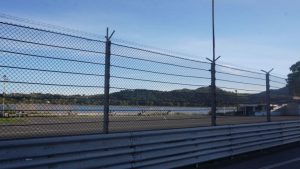 Then came the motor racing circuit, permanently changing the character of the area. In 1959, one of the symbols of Sicily’s post-war modernisation began to take shape along the lake shores: a motor racing circuit approximately five kilometres long, built around the body of water and designed to host internationally significant competitions. It was an era of faith in progress, of speed as a promise and technology as a solution. For several years, Pergusa also became a venue for Formula One and major motor-racing events. That decision, however, created a profound rupture: “The construction of the racing circuit in 1959 was seen as a symbol of modernity, a hymn to the future, but it had a profound impact on the balance of the lake,” Amato explains. The problem was not merely the presence of the infrastructure, but the way in which it interfered with a dynamic natural system: “The circuit imposed an artificial limit on the water level, establishing a maximum height and altering the way the lake functioned.”
After the first floods covered the track in the months following its inauguration, a control system was built: an overflow channel preventing the lake from exceeding a certain threshold. In other words, a “plug” was introduced into a system that had previously been free to expand and contract: “This was one of the first major interventions imposed on the lake: a natural system was transformed into a controlled one, without the consequences ever being properly understood.” Artificial regulation interrupted the natural expansion of the water, reduced the surrounding wetlands and altered exchanges between the lake and the aquifer. The result was a gradual loss of water flow: “Sixty years later, we are paying the price for that decision: Pergusa has lost part of its ability to regulate itself.”
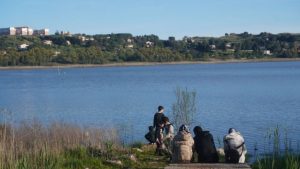
Today, the lake appears full of water. On the sunniest days, its shores are populated by families with children playing football, students from Kore University and elderly residents of the village walking around the lake’s perimeter. In the summer of 2024, however, “it was on the verge of disappearing, and you could practically walk across its bed,” Amato recalls. During those months, and continuing into part of 2025, the Enna area experienced one of the most severe water crises in its recent history: continuous rationing, networks under pressure and water supplied in shifts across dozens of inland municipalities. The crisis was caused not only by the lack of rainfall, but by a prolonged drought aggravated by record heat and increasingly warm nights, which accelerated evaporation and prevented the system from recovering. Reservoirs gradually lost capacity, aquifers declined and high temperatures transformed scarcity into a permanent emergency. “Many people think that water disappears because we consume it,” Amato observes. “In reality, it also disappears because it evaporates increasingly quickly. If temperatures remain high even at night, the system no longer has time to recover.”
 The crisis also brought the structural weaknesses of water management in Sicily back into focus. The island depends largely on a system of dams and artificial reservoirs built after the Second World War to store water during rainy months and redistribute it during dry periods, thereby offsetting the region’s historically irregular climate. Over time, however, this system developed into a complex network of separate responsibilities and management structures: different organisations operate within the same area during the various stages of the service—water collection, conveyance, distribution and treatment—without genuinely effective coordination. Siciliacque manages interprovincial water transfers and the major regional aqueduct systems, while local distribution depends on other operators. This is compounded by obsolete networks, high leakage rates, widely differing conditions across the region and even within individual provinces, and a system based more on emergency response than prevention.
According to Amato, this structure itself aggravated the 2024 crisis. “We had asked for rationing to begin as early as November 2023,” he says. “It was perfectly clear that water levels were falling and that the system would not recover without immediate intervention.” Rationing was postponed, however, while reservoirs continued to lose volume and temperatures remained exceptionally high. In many inland municipalities, water was supplied for only a few hours every five or six days, amid water tankers, private storage tanks and constant disruption for residents and businesses. For Amato, the problem is not solely climatic: “Many people think that water disappears because we consume it. In reality, it also disappears because it evaporates increasingly quickly.” It is in this combination of drought, extreme heat and lack of planning that Sicily’s water crisis ceases to appear as an exceptional event and takes on the characteristics of a permanent vulnerability.
One of the most emblematic episodes of the crisis concerned the Ancipa dam, the main reservoir supplying many of the municipalities in the northern part of the Enna area—Troina, Nicosia, Sperlinga, Cerami and Gagliano Castelferrato—as well as part of the province of Caltanissetta. Built after the Second World War to regulate water distribution across inland Sicily, Ancipa has been a strategic hub of the regional water system for decades. Its history, however, is also marked by the tragedy that killed thirteen workers during the construction of the reservoir in December 1950.
During 2024, the level of the Ancipa reservoir gradually declined along with that of Sicily’s other reservoirs. In many municipalities, supply was reduced to the bare minimum—only a few hours, a few times a week—and private, expensive water tankers became part of residents’ daily lives: the entire area entered a state of permanent emergency. However, while the reservoir continued to lose volume, transfers towards the Caltanissetta area continued, and what had appeared to be a climate-related crisis became a social issue. The mayors of the northern Enna area accused Siciliacque and the Regional Steering Committee of delaying rationing and continuing to distribute water outside the area despite the progressive depletion of the Ancipa reservoir. For days, they demanded an immediate reduction in flows towards Caltanissetta and San Cataldo, arguing that their municipalities were at risk of complete water-system collapse. The response was slow to arrive, while the reservoir level continued to fall.
On 30 November 2024, tensions erupted: the mayors of Troina, Nicosia, Sperlinga, Cerami and Gagliano Castelferrato occupied the Ancipa Basso drinking-water treatment plant together with residents, local administrators and community committees. The pipelines towards the Caltanissetta area were closed, and the occupation continued for several days amid improvised assemblies, negotiations with the Prefecture and mutual accusations. Siciliacque reported tampering with the facilities and disruption of the service, while the mayors rejected the idea that this was a “war between territories”, describing it instead as an unavoidable decision intended to prevent thousands of people from being left without water.
In the end, pressure on the Ancipa reservoir eased only with the return of rainfall between late 2024 and early 2025, relieving a crisis that had reached breaking point. For Amato, however, “The emergency was not managed. They simply waited for the weather to change.” Within a management system that remains fragmented between different responsibilities, authorities and organisations, water scarcity therefore continues to be addressed only when territories and communities are already close to collapse. Quite simply, by waiting for the rain.