
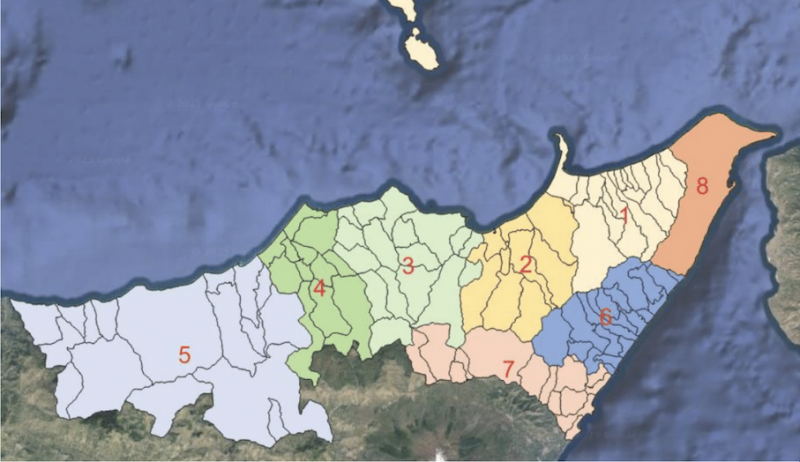

In Messina, the governance structure is nothing short of a charade, partly due to the large number of municipalities and the territory’s lack of uniformity. The area’s master plan reveals that the water supply and distribution service for the province’s 108 municipalities involves 90 municipal operators, three public entities (EAS, long in liquidation, ASM Taormina, and A.C.A.V.N.), and AMAM S.p.A., a company owned by the Municipality of Messina that manages the drinking water supply for the provincial capital. There is also a mixed management arrangement involving Siciliacque S.p.A., the regional wholesale water supplier, which is 75% owned by Italgas S.p.A. and 25% by the Sicilian Region. Serving the 108 municipalities that make up the Integrated Territorial Area (ATI), the governing body for the integrated water service, which aligns with the province of Messina, are no fewer than 122 aqueducts, divided into eight districts.
What are the consequences of this administrative maze? First and foremost, inefficient resource management: of the 313 wells (71 of which are inactive), 12% (37 wells) fail to meet adequacy standards, and 16% (49 wells) have undergone no quality assessment. Regarding springs, with 491 active out of a total of 587, 30% (175 springs) fail to meet adequacy standards, and 7% have not been assessed for quality.
Apart from the provincial capital, there is no precise data regarding water supply: assessments conducted during the drafting of the integrated water service area plan revealed, with the sole exception of facilities managed by AMAM S.p.A. and a few other municipalities, an almost total lack of metering systems for abstracted and conveyed water. Consequently, it is impossible to accurately track the volumes abstracted and fed into conveyance systems, or to measure losses occurring within this infrastructure and the distribution networks. Indeed, the only available information comes from the report titled “Volumes of water input, water supplied for authorized uses, and total water losses in municipal drinking water distribution networks by province – Year 2015,” which indicates that 45.1% of the water fed into the network in the province of Messina is lost.
The only specific data available concerns the provincial capital, Messina, where losses hover around 53% (comprising 26.7% lost to actual leakage and 27% classified as “unaccounted-for volumes”). These losses are driven by the characteristics and age of the city’s tertiary network, built over 40 years ago and requiring constant repairs, which necessitates systematic daily supply rationing (i.e., scheduled interruptions unrelated to external events). Work to completely replace the city’s tertiary network is currently underway.
Regarding the condition of the infrastructure, the assessment did not reveal widespread inefficiency stemming from the age or poor state of the piping; instead, 18% of existing assets were rated as being in poor condition, and 7% in very poor condition. Beyond network inefficiency and aging, critical issues also arise from the territory’s geomorphological fragility, which has led to significant service interruptions. A striking case involved the Fiumefreddo Aqueduct: in late October 2015, a landslide in the municipality of Calatabiano damaged the supply pipeline, disrupting the water supply to the city of Messina (located about 60 km from Calatabiano) for nearly a month.
Find out about the situation in other Sicilian provinces here.