

“Declaring a state of regional crisis and emergency due to the severe water crisis affecting the drinking water supply in the provinces of Agrigento, Caltanissetta, Enna, Messina, Palermo, and Trapani.” With these words, contained in a resolution adopted by Renato Schifani’s government on March 11, 2024, the Sicilian Region officially acknowledges, both administratively and politically, the existence of a water crisis unprecedented in recent times. This marks the formal onset of the 2024 water emergency, the most severe the island has seen in decades, in some respects even more acute than the crisis of 2001–2002 in terms of both duration and geographical extent.
In reality, the signs had been evident for weeks. In January, the height of the rainy season, Sicilian reservoirs held 18% less water than in the same month of 2023, a year already marked by scarce rainfall, particularly in its second half. Figures that were hard to ignore demonstrated the severity of the situation. The Pozzillo Dam on the Salso River, an integral part of the Salso-Simeto water system, which is crucial for the water, irrigation, and hydroelectric needs of the Catania Plain and surrounding areas, has a total capacity of 150 million cubic meters; yet, in January 2024, it held just over three million. The Disueri Dam on the Gela River, with a capacity of 23.60 million cubic meters, held a mere 0.52 million. The Fanaco Dam on the Platani River—which feeds the aqueduct systems supplying various towns in southwestern and central Sicily—held only 3 million cubic meters out of a total capacity of nearly 21 million. The Cimia reservoir, capable of holding ten million cubic meters, contained only 0.71 million. The Comunelli Dam, on the river of the same name, was completely dry. Thus, in the middle of winter, Sicily was already facing conditions typically seen at the end of summer: water reserves were not being replenished.
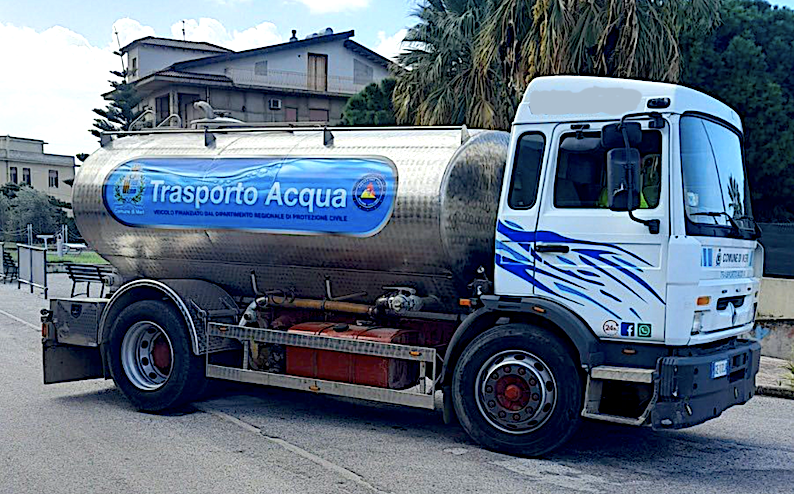
The first measure adopted? Water supply rationing. Starting Monday, January 8, 2024, Siciliacque, a company 25% owned by the Sicilian Region and 75% by the private firm Idrosicilia S.p.A. (which manages the island’s supra-municipal water service), reduced water flow by 10% (and in some cases by 15%) to 39 municipalities in the provinces of Agrigento, Caltanissetta, and Palermo, as well as to two land reclamation consortia (Agrigento 3 and Caltanissetta 4) directly connected to the Fanaco reservoir or to other aqueducts fed by it. From January 12, following the completion of work on the Garcia aqueduct system, 15 municipalities in the province of Trapani were also included in the reduction plan.
The near-total absence of rainfall during the spring exacerbated an already dire situation. According to SIAS (the Sicilian Agrometeorological Information Service), spring rains failed to provide significant water input; almost everywhere, the precipitation merely moistened the topsoil, from which it quickly evaporated. The regional average monthly rainfall in Sicily was approximately 8 mm, below the norm for the 2003–2022 period, which stands at around 11 mm.
The severity of the situation was further highlighted by cumulative annual rainfall data. By the end of June 2024, rainfall recorded over the preceding twelve months, averaging 414 mm across the region, had dropped to levels comparable to the major drought of 2002, when the regional average accumulation for the same period was 413 mm. In some areas of the island, the annual rainfall deficit exceeded 60%.
The crisis peaked between June and July, with the twenty-nine Sicilian reservoirs monitored during that period by the Sicily Hydrographic District Basin Authority, used for drinking water, irrigation, power generation, and industrial purposes, holding 73% less water than their total usable capacity of 1,010.70 million cubic meters. In June, facing the prospect of the dry season still ahead, the reservoirs held a mere 288 million cubic meters of water, less than one-third of their available capacity. A comparison with the previous year highlights the severity of the crisis even further. Following rainfall in May and the first half of June 2023, the reservoirs had held 520 million cubic meters of water and were filled to approximately half their capacity. In some instances, the situation was truly catastrophic. The Comunelli and Zaffarana reservoirs were completely dry. In June, the Pozzillo dam held just 5 million cubic meters of water. The Disueri and Fanaco dams were almost entirely dry, with levels of 0.21 and 0.45 million cubic meters, respectively.
The institutional response was drastic. Out of a total population of 4,779,371, some 2,347,142 Sicilians, nearly half the region’s entire population, experienced reductions in water supply. In many instances, these cutbacks affected distribution systems that, even under normal conditions, rarely guarantee a continuous, round-the-clock supply. Rationing measures also impacted areas of the region traditionally less vulnerable to drought. A prime example is the Ancipa Dam, a strategic multi-purpose facility within the water system of eastern Sicily. There, the combined effect of a prolonged drought throughout much of the autumn and a lack of preventive measures to curb consumption in the preceding months led to the near-total depletion of stored water, jeopardizing the drinking water supply for municipalities such as Troina, Gagliano Castelferrato, Cerami, Nicosia, and Sperlinga.
The summer of 2024 unfolded amidst an environmental catastrophe: cities without water, countryside literally scorched by the sun, empty reservoirs, and lost harvests, in parts of Sicily, the decision was made to sacrifice low-growing crops like wheat in favor of taller plants, simply because the former can be replanted annually while trees take decades to mature. Meanwhile, the political establishment floundered, unable to look beyond the immediate crisis; when backed into a corner, it resorted to solutions that were fanciful, inefficient, and even harmful. Then, at the end of August, it finally rained. Not much, but it rained. Yet the crisis did not abate.
For a regular supply of water to the soil, it is not enough for it simply to “rain” in a general sense. The rainfall needs to be “steady,” for instance; downpours, thunderstorms, and “cloudbursts” do not affect drought indices because the large volumes of water involved cannot permeate the ground, due to the speed at which they run off, and thus fail to alleviate the drought (while actually damaging the landscape through flooding). Indeed, the soil, especially at greater depths, can take at least a couple of years to fully regain optimal moisture levels following a severe drought, a process that takes even longer when it comes to replenishing water reserves; all this assumes there are no major precipitation anomalies (or that any such anomalies are negligible). In fact, the situation will not stabilize until early 2026, thanks to rainfall that generated a surplus, finally making up for significant portions of the precipitation deficit accumulated over previous years and marking an end to both agronomic and hydrological drought. This comes a year and a half after the worst water crisis of the last twenty years.