
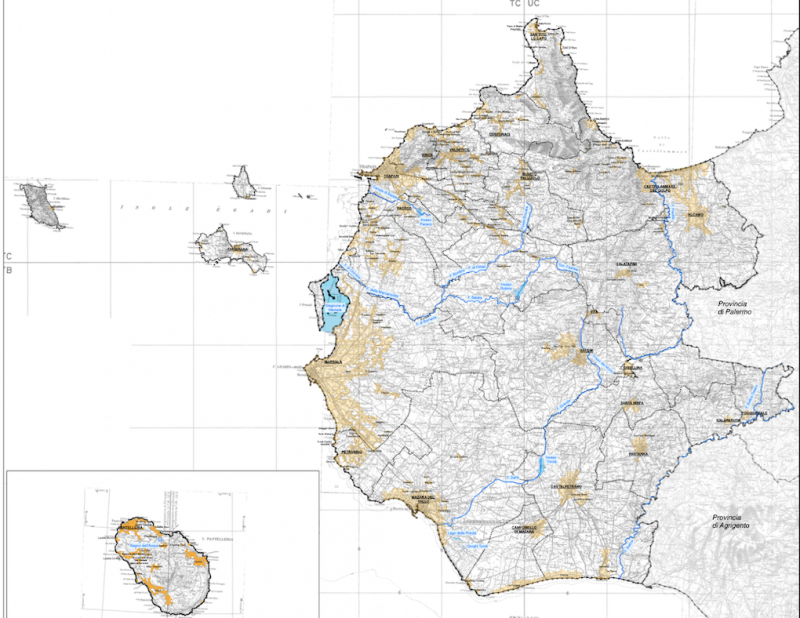


The water supply system in the Trapani area faces a serious problem regarding data acquisition, as the available data is both scarce and imprecise. The report accompanying the area plan, approved in 2002 and updated in 2021, notes, for instance, that “wells, springs, and the supply lines feeding municipal reservoirs currently lack functional volumetric and flow meters, tools essential for an accurate water balance and for quantitatively assessing the water supplied and fed into the network.” It also laments the “absence of thematic maps that would allow for the identification of network routes and conditions, as well as the detection of leaks, which are estimated to exceed 50% across the territory on average.” However, the table for “Phase 3 – Demand Analysis” highlights an “average rate of apparent network water losses, relative to the volume fed into the system, of 58%.” This discrepancy stems precisely from the lack of standardized measurements. “If we look at the municipalities supplied exclusively by resources purchased from Siciliacque, which are measured reliably (Custonaci, Gibellina, Paceco, Poggioreale, Salaparuta, Santa Ninfa, Vita), thereby eliminating the uncertainty surrounding the quantity of local water resources actually extracted and fed into the network, the loss figure is confirmed (57.2%),” the report explains.
Some of the loss estimates are extremely high: the provincial capital reports a 63% loss of the volume fed into the network, while figures exceed 70% in Buseto and reach an astonishing 84% in Salemi. Yet, in its 2022 survey, ISTAT attributes a remarkably low loss rate of 17.2% to the city of Trapani.
That is not all. The report notes a “lack of supply lines connecting reservoirs to key nodes of the distribution network, lines that would enable the continuous, 24-hour servicing of different elevation zones rather than relying on rotational supply based on pressure zones; a lack of a rational, comprehensive distribution network in expansion areas, particularly those characterized by ‘spontaneous expansion’ currently undergoing redevelopment and building legalization; and a failure to carry out routine or major maintenance in neighborhoods with steel or grey cast-iron networks, where leakage rates exceed 50% and service standards for end-users are very poor.”
Furthermore, according to the area plan, “wells and springs, as well as the supply lines feeding municipal reservoirs, currently lack functional volumetric and flow meters, devices essential for an accurate water balance and for quantitatively assessing the water supplied and fed into the network”. As highlighted in the Sicilian Region’s General Master Plan for Aqueducts, a large portion of the water infrastructure in the province of Trapani was built between the 1960s and 1980s, meaning that in many cases, it has been in use for over forty years.
Find out about the situation in other Sicilian provinces here.