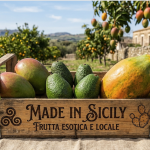

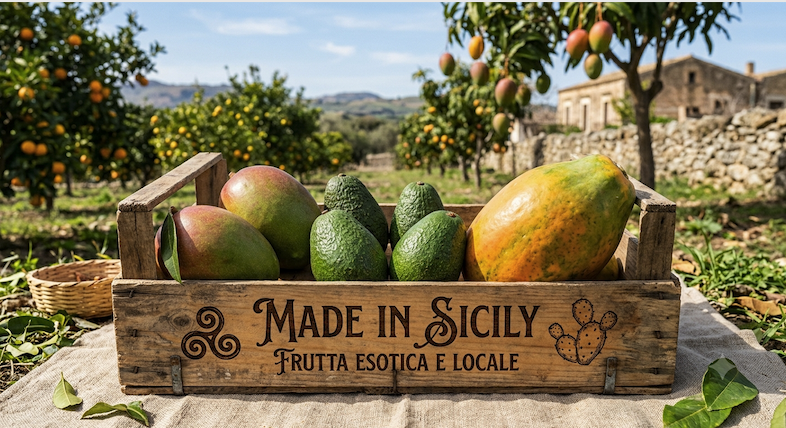


In Sicily, climate change is visible not only in empty reservoirs, water tankers and mayoral emergency orders. It can also be seen in the fields. Along certain coastal areas, where citrus fruit, olive trees, vineyards and arable crops dominated for generations, mangoes, avocados, papayas, limes, lychees and custard apples have begun to appear. This is not exotic folklore, but rather the new space being occupied by plants that are sensitive to winter frosts, which were once very common and have now almost entirely disappeared. Above all, it is an entrepreneurial response to an ever-changing climate and to markets that offer better returns.
The phenomenon is not limited to fresh fruit. In Avola, sugar cane cultivation has also been revived for the agricultural production of rum, recalling a tradition documented in Sicily as early as the nineteenth century. These are different examples, but they tell the story of the same transformation: the island’s increasingly warm climate, combined with the search for more profitable crops, is encouraging some farms to move towards high-value tropical and subtropical production. Coldiretti has even reported the emergence of high-value processed-product supply chains, such as coffee production in the Ragusa area and avocado oil production at the foot of Mount Etna. Beyond the nostalgic regrets of those who remember Sicily as Italy’s breadbasket, one question is increasingly being asked: is this new form of agriculture compatible with an island where less and less water is available?
Judging by the figures, the answer justifies neither easy alarmism nor automatic absolution. The data show that tropical crops are certainly not the cause of Sicily’s water crisis: the area they occupy remains minimal compared with the island’s total agricultural land. However, those who dismiss them as irrelevant are also mistaken. The issue is not only how many hectares they occupy today, but where they are planted, during which months they require water, which sources that water comes from and what current trends allow us to anticipate about the future.
In numerical terms, Sicilian agriculture is still predominantly based on traditional crops. According to the CREA report Agriculture in Sicily in Figures 2024, the region’s utilised agricultural area amounts to 1,347,098 hectares, approximately 52% of the island’s total surface area. In 2022, cereals occupied 280,578 hectares, temporary fodder crops 214,868 hectares, olive trees 161,137 hectares, vineyards 138,124 hectares, citrus fruit 86,078 hectares, fruit trees 74,754 hectares and vegetable crops 71,112 hectares. Within this overall picture, tropical crops remain a limited and localised presence, probably accounting for less than 0.1% of the region’s agricultural land—although no precise estimates are available—and certainly not the main body of Sicilian agriculture.
Through Terrà, its online agricultural portal, the Sicilian Regional Government itself describes the phenomenon as a rapidly evolving transformation that “escapes classification and statistics”. In the municipalities of Caronia, Acquedolci, Sant’Agata di Militello and Torrenova, in the province of Messina, the area devoted to tropical crops is estimated at approximately 100 hectares, mainly planted with mangoes, with a further 50 hectares under development in Tusa and another 20 hectares between Caronia, Torrenova and Capo d’Orlando. At national level, Coldiretti reports more than 1,200 hectares of tropical crops, concentrated primarily in Sicily, Apulia and Calabria. The first point is therefore clear: it cannot be claimed that mangoes and avocados have drained Sicily dry. That would be a simplistic narrative shortcut. The second point, however, is equally important: a small cultivated area does not automatically mean a small local impact. In irrigated agriculture, the regional scale matters, but so do the individual basin, aquifer, well, reservoir and irrigation schedule.
The Water Footprint
Scientific debate frequently uses the concept of the water footprint, by analogy with the carbon footprint used in relation to climate change. The water footprint measures the volume of water used directly and indirectly throughout the production of a good. It therefore does not simply indicate how much water is poured onto a field, but takes into account every stage involved in producing a particular product. Its usefulness lies primarily in the distinction between three components: green water, blue water and grey water.
Green water is rainfall retained in the soil and subsequently used by plants. Blue water is water withdrawn from surface or underground sources, including rivers, reservoirs, wells and aquifers. Grey water is the theoretical volume required to dilute the pollution generated by production, for example from fertilisers and pesticides. This distinction is crucial for a territory such as Sicily. One hectare of rain-fed durum wheat, sustained by winter rainfall, does not have the same water impact as an irrigated orchard requiring water during the summer months. Two crops with similar water requirements may also have very different impacts if one relies mainly on green water and the other on blue water. While green water is essentially free of cost for the production system, blue water is diverted from other uses, placing it in direct competition with domestic or industrial consumption.
In Sicily, competition between water for irrigation and water for drinking purposes does not arise solely from a generic conflict between fields and cities. It often involves shared or coordinated sources, reservoirs and infrastructure within the same regional system. This is demonstrated by recent decisions concerning the Fanaco, Leone, Ancipa, Pozzillo and Castello reservoirs, in which allocations to the agricultural sector are assessed in relation to the reliability of the drinking-water supply. It can also be seen in older local cases, such as that of the Petroieni spring in Santo Stefano Medio, in the municipality of Messina. According to reconstructions by the local press, a civil lawsuit in the 1930s between the municipality and local landowners reportedly recognised the seasonal priority of irrigation use for the “Petroieni e Fontana” consortium, assigning the surplus flow to the municipal aqueduct. This is a small but telling example of how the boundary between water for agriculture and water for cities may depend on usage rights, rotational allocation, surplus availability and specific hydrological conditions.
In 2022, regional rainfall was measured at approximately 515 millimetres, with an average deficit of 165 millimetres, equivalent to 24% below the reference climate level. Rainfall was also below average in 2023 and 2024: quantities were insufficient to build up adequate winter water reserves for the summer, when low rainfall is the norm. The most recent picture is even more severe. In its 2025 report on water statistics, ISTAT states that in 2024, 99.2% of Sicilian farms—virtually all of them—reported irrigation difficulties. This is the context in which every new choice of crop also becomes a choice about water.
The danger in public debate is the creation of an overly convenient opposition: traditional “Sicilian” crops on one side and “exotic” crops on the other. From the standpoint of water use, however, this distinction is not particularly meaningful. Some of the island’s long-established crops are extensively irrigated. ISTAT reports that, in the 2019/2020 agricultural year, 83.8% of the area devoted to citrus fruit among permanent crops was irrigated, as was 47.9% of the area planted with fruit trees, 35.5% of vineyards and 12.6% of olive groves. Among arable crops, open-field vegetables reached an irrigation rate of 80.6%.
The real distinction, therefore, is not between “native” and “tropical” crops, but between different production systems: rain-fed crops or crops with limited summer water requirements on the one hand, and irrigated, intensive and permanent crops on the other. A traditional citrus grove may be far more dependent on irrigation than an extensive olive grove. A vegetable field may require much more water than a rain-fed vineyard. Nor is a mango orchard automatically more problematic than any traditional crop: it becomes critical when it is introduced into an area where available blue-water resources are already fully exploited.
Why, then, do tropical crops generate so much debate? Because they are a perfect symbol. They simultaneously represent global warming, the crisis affecting citrus fruit in certain production areas—which is primarily an economic crisis—the search for income among farmers and the risk of shifting water pressure towards more profitable but water-intensive crops. Terrà reports that, in certain Sicilian environments, intensive mango orchards aged six to seven years can produce up to 150 quintals per hectare, with average producer prices of approximately €3 per kilogram for conventionally grown fruit and €4 for organic fruit. In approximate terms, this corresponds to gross revenues of €45,000 to €60,000 per hectare before costs, considerably higher than the returns available from citrus cultivation.
This is where the economic rationale behind conversion becomes clear. For a farming business, replacing a poorly remunerated crop or a struggling citrus grove with a high-value fruit crop may mean remaining competitive in the market. Farmers themselves cannot therefore be blamed. The real problem, where one exists, is crop conversion that is not supported by transparent water data, territorial planning, withdrawal limits, the reuse of treated wastewater and highly efficient irrigation systems.
How Much Water Does a Sicilian Mango Require?
Calculating the water footprint of a tropical product grown in Sicily is not straightforward. A mango grown in one particular location will not necessarily have the same footprint as a mango cultivated elsewhere: soils, rainfall, salinity, groundwater quality, irrigation techniques, planting density and, above all, yields all vary. Moreover, there is still no consolidated public statistical framework covering the water requirements of tropical crops grown on the island. International literature can therefore be used as a benchmark, but not as direct evidence.
A study of mango production in the semi-arid Vale do São Francisco region of Brazil estimated an average annual water consumption of approximately 13,048 cubic metres per hectare for agricultural production alone. In the same study, full production was estimated at around 40 tonnes per hectare per year. Conservatively translated, this represents an order of magnitude of approximately 300 to 400 cubic metres per tonne under those specific production conditions. If yield per hectare decreases, however, the water footprint per kilogram increases.
Comparison with other crops shows how strongly the data depend on context. An Australian study covering nine agricultural products reports widely differing figures: 212 cubic metres per tonne for tomatoes, 226 for potatoes, 329 for carrots and turnips, 681 for oranges, 743 for grapes, 827 for apples, 1,777 for peaches and nectarines, 2,116 for cherries and 6,672 for almonds. These figures refer to a different production environment and cannot be transferred directly to Sicily. They do, however, help to avoid simplistic conclusions: describing a crop as “tropical” is not enough to establish that it is automatically the most water-intensive.
For Sicily, the real issue lies elsewhere: mangoes and other tropical crops require reliable irrigation precisely during the most climatically sensitive months. Their sustainability must therefore be assessed not only in cubic metres per tonne, but also in terms of available blue water, the source of withdrawals, irrigation efficiency, economic productivity per cubic metre and compatibility with other agricultural, domestic and ecosystem uses.
Another factor also helps to put selective alarm over tropical crops into perspective: agricultural pressure on Sicily’s water resources has long existed in protected cultivation and intensive horticulture. A 2012 study by Cellura, Ardente and Longo on protected crops in a district of southern Italy examined an area between Licata and Palma di Montechiaro. The area covered 18 square kilometres, included approximately 150 small and medium-sized agricultural enterprises, employed 700 workers, produced 75 million kilograms of protected crops per year and generated an economic output of approximately €40 million.
As early as 2008, Sicily was identified as Italy’s leading region for protected cultivation, with approximately 53 square kilometres of greenhouses and around 440 million kilograms of greenhouse vegetables. In the case study, water consumption per 1,000 kilograms of produce varied considerably: 84.3 cubic metres for tomatoes grown in pavilion greenhouses, 136.6 for melons grown under the same system, approximately 104–105 for peppers and as much as approximately 155–158 for courgettes grown in tunnels. Under different production scenarios, the range could become much wider: for melons, for example, from 91.3 to 238 cubic metres per tonne; for peppers, from 71.5 to 240.7. This demonstrates that yield, production technique and farm management can matter just as much as the crop species itself.
The lesson is also relevant to tropical crops: it is not enough simply to say “yes to mangoes” or “no to mangoes”. Measurement is essential. An orchard equipped with micro-irrigation, soil-moisture monitoring, mulching, suitable cultivars and regulated water withdrawals does not have the same impact as one established without any genuine system of water accounting.
The War Between Fields and Cities
When water is scarce, conflict between agricultural and urban uses becomes inevitable. However, the issue must be explained accurately. Water resources intended for drinking and those intended for irrigation do not always coincide: they may come from different sources—springs, wells, tunnels, watercourses, natural lakes and artificial reservoirs—and may be collected and transferred to users through separate infrastructure and water networks. Competition becomes tangible when the same sources and/or the same water-supply systems are involved. In Sicily, this potential conflict is aggravated by inefficient water systems and persistent fragmentation in their management.
ISTAT also reports that self-supply systems for irrigation prevail in central and southern Italy, accounting respectively for 69.2% and 49.8% of irrigated land. This means that a significant share of agricultural water does not necessarily pass through large collective systems, but instead comes from wells, aquifers, small reservoirs and farm-owned resources—as well as, potentially, illegal connections to the network and unmetered volumes, as was discovered on the Fiumefreddo pipeline following the 2015 landslide.
The question is therefore not simply whether agriculture consumes too much water, but whether total withdrawals are known, authorised, sustainable and compatible with the natural replenishment of resources. It must also be remembered that even when a well is privately owned, the aquifer is shared: anyone drawing from a basin may ultimately cause other people’s wells to run dry as well.
Sicilian public debate often lacks one decisive indicator: the economic value generated per cubic metre of water. One crop may consume a large amount of water per hectare but generate high income; another may consume less while producing little value; a third may be only marginally profitable but essential to the landscape, biodiversity, soil conservation or local identity. Agricultural policy cannot be reduced to a mechanical ranking of “litres per kilogram”. It must combine water requirements, water sources, withdrawal periods, income, employment, environmental risk and climate resilience. Policy must also ensure that the most profitable crops generate the reinvestment required to guarantee their own sustainability.
Conviction or Acquittal?
We can therefore state that mangoes and avocados are not responsible for Sicily’s water shortage. The areas devoted to tropical crops are still far too limited to explain the water crisis of a region with more than 1.3 million hectares of agricultural land. Precisely for this reason, however, they represent an important warning sign. They force us to examine a much broader transformation: Sicilian agriculture is adapting to a warmer climate and more selective markets, while water availability is becoming increasingly uncertain.
The choice is not between nostalgia and innovation. It is not between oranges and avocados, or between wheat and mangoes. It is between conversion driven solely by market prices and conversion governed by water accounting as well. In a Sicily where almost every farm reports irrigation difficulties and where residents are becoming increasingly familiar with water rationing, every irrigated hectare is a public decision as well as a private one.
The question, therefore, is not whether the island should grow tropical fruit. The question is how much water it can afford to allocate to any crop, under what limits, with what controls and according to what vision for its agricultural future.